
Mine tailing is the waste materials left after the excavation of valuable mineral resources. It is an environmental pollutant which are often rich in metal ions, can be harnessed and used as a reagent salt substitute to synthesize nanoparticles. The copper tailings can be managed by converting it to copper nanoparticles for various purposes. This research is focused on conversion of waste (excavated copper waste) to wealth (copper nanoparticles). The synthesis of copper nanoparticles from tailings is a novel approach of recovering copper from copper tailings. The aim of this research is to synthesize and characterize copper (Cu) nanoparticles from copper tailings and reagent copper salt using sodium borohydride as a reductant. Chemical reduction method was used in the synthesis of copper nanoparticles from copper tailings and reagent copper salt Experimental approach: Pulverized copper tailing (PCT) particles was digested and the filtrate was analyzed to identify and quantify the cations and anions using Inductively Coupled Plasma Optical Emission Spectroscopy (ICP-OES) and Ion Chromatography (IC) respectively. The digested filtrate was used to synthesize copper nanoparticles by chemical reduction method. Characterization of the synthesized copper nanoparticles was conducted using techniques such as X-Ray Diffraction (XRD), X-Ray Fluorescence (XRF), ThermoGravimetric Analysis (TGA), Fourier Transform Infrared (FTIR), Bruner Emmett Teller (BET), Scanning Electron Microscopy (SEM) and the Transmission Electron Microscopy (TEM). Results: The ICP-OES identified Cu from PCT to be the predominant cation (1355.25 mg/L), and IC identified sulphate (838.50 mg/L) to be the predominant anion. The XRD of the particles are crystalline. TGA results revealed the stability of PCT, Synthesized tailing Cu NPs and reagent Cu NPs at 282.31°C, 297.70°C, and 311.37°C while BET shows the surface area at (157.52 m2/g), (178.54 m2/g), and (189.93 m2/g) respectively. The SEM and TEM revealed spherical particle shape for all the samples. In conclusion: the quality of the synthesized tailing Cu NPs and reagent Cu NPs are almost similar. Also, the PCT can be used as a substitute to reagent copper salt to synthesize Cu NPs. The novelty of this research is comparing Cu NPs synthesized from tailing and reagent salt.
| Published in | American Journal of Nanosciences (Volume 10, Issue 1) |
| DOI | 10.11648/j.ajn.20261001.13 |
| Page(s) | 29-40 |
| Creative Commons |
This is an Open Access article, distributed under the terms of the Creative Commons Attribution 4.0 International License (http://creativecommons.org/licenses/by/4.0/), which permits unrestricted use, distribution and reproduction in any medium or format, provided the original work is properly cited. |
| Copyright |
Copyright © The Author(s), 2026. Published by Science Publishing Group |
Copper Tailing, Digestion, Synthesis, ICP-OES, Characterization
Physicochemical Parameters | WHO Standard |
|---|---|
TDS | 300-600 mg/L |
TSS | < 500 mg/L |
COD | < 100 mg/L |
EC | ≤ 400 µScm |
pH | 6.5-8.5 |
Salinity | ≤ 0.5 ppt |
Temperature | ≤ 25 oC |
BOD | < 30 mg/L |
PCT | Pulverized Copper Tailings |
Tailing Cu NPs | Tailing Copper Nanoparticles |
Reagent Cu | Reagent Copper Nanoparticles |
BET | Bruanuer-Emmette-Teller |
FTIR | Fourier Transform Infrared |
SEM | Scanning Electron Microscopy |
TEM | Transmission Electron Microscopy |
TGA | Thermogravimetric Analysis |
XRD | X-ray Diffraction |
XRF | X-ray Flourescence |
IC | Ion Chromatography |
ICP-OES | Inductively Coupled Plasma-Optical Emission Spectrometry |
NaBH4 | Sodium Borohydride |
HNO3 | Nitric Acid |
HCl | Hydrochloric Acid |
FeCl3 | Ferric Chloride |
DO | Dissolved Oxygen |
EC | Electrical Conductivity |
TDS | Total Dissolved Solids |
COD | Chemical Oxygen Demand |
BOD | Biological Oxygen Demand |
TSS | Total Suspended Solids |
| [1] | Chen, M., He, Y., Ye, Q., Zhang, Z., Hu, Y., 2019. Solar thermal conversion and thermal energy storage of CuO/Paraffin phase change composites. Int. J. Heat Mass Tran. 130, 1133–1140. |
| [2] | Ali, J., Ali, N., Wang, L., Waseem, H., & Pan, G., 2019. Revisiting the mechanistic pathways for bacterial mediated synthesis of noble metal nanoparticles. J. Microbiol. Methods 159, 18–25. |
| [3] | Szczyglewska, P., Feliczak-Guzik, A., & Nowak, I. (2023). Nanotechnology–general aspects: A chemical reduction approach to the synthesis of nanoparticles. Molecules, 28(13), 4932. |
| [4] | Pomerantseva, E., Bonaccorso, F., Feng, X., Cui, Y., & Gogotsi, Y. (2019). Energy storage: The future enabled by nanomaterials. Science, 366(6468), eaan8285. |
| [5] | Das, M. P. (2010). Mesoscopic systems in the quantum realm: fundamental science and applications. Advances in Natural Sciences: Nanoscience and Nanotechnology, 1(4), 043001. |
| [6] | Bora, T., Dousse, A., Sharma, K., Sarma, K., Baev, A., Hornyak, G. L., & Dasgupta, G. (2019). Modeling nanomaterial physical properties: theory and simulation. International Journal of Smart and Nano Materials. |
| [7] | Tayebi-Khorami, M., Edraki, M., Corder, G., & Golev, A. (2019). Re-thinking mining waste through an integrative approach led by circular economy aspirations. Minerals, 9(5), 286. |
| [8] | Araujo, F. S., Taborda-Llano, I., Nunes, E. B., & Santos, R. M. (2022). Recycling and reuse of mine tailings: A review of advancements and their implications. Geosciences, 12(9), 319. |
| [9] | Edraki, M., Baumgartl, T., Manlapig, E., Bradshaw, D., Franks, D. M., & Moran, C. J. (2014). Designing mine tailings for better environmental, social and economic outcomes: a review of alternative approaches. Journal of Cleaner Production, 84, 411-420. |
| [10] | Mancini, S., Casale, M., Tazzini, A., & Dino, G. A. (2024). Use and recovery of extractive waste and tailings for sustainable raw materials supply. Mining, 4(1), 149-167. |
| [11] | Singh, S., Maurya, P., Karmakar, A., Maurya, P. K., Pandey, N., Kumar, S., & Gupta, T. (2025). Mining tailings as a frontier for sustainable nanomaterials: advancing circular economy and environmental innovation. Environmental Geochemistry and Health, 47(7), 265. |
| [12] | Zvarivadza, T., & Nhleko, A. S. (2018). Resolving artisanal and small-scale mining challenges: Moving from conflict to cooperation for sustainability in mine planning. Resources Policy, 56, 78-86. |
| [13] | Merem, E. C., Twumasi, Y., Wesley, J., Isokpehi, P., Shenge, M., Fageir, S. & Nwagboso, E. (2017). Assessing the ecological effects of mining in West Africa: The case of Nigeria. International Journal of Mining Engineering and Mineral Processing, 6(1), 1-19. |
| [14] | Otoijamun, I., Kigozi, M., Abdulraman, S. O., Adetunji, A. R., & Onwualu, A. P. (2021). Fostering the sustainability of artisanal and small-scale mining (ASM) of Barite in Nasarawa State, Nigeria. Sustainability, 13(11), 5917. |
| [15] | Gabasiane, T. S., Danha, G., Mamvura, T. A., Mashifana, T., & Dzinomwa, G. (2021). Environmental and socioeconomic impact of copper slag—A review. Crystals, 11(12), 1504. |
| [16] | Si, M., Chen, Y., Li, C., Lin, Y., Huang, J., Zhu, F. & Zhao, Q. (2022). Recent advances and future prospects on the tailing covering technology for oxidation prevention of sulfide tailings. Toxics, 11(1), 11. |
| [17] | Zhang, T., Zhang, C., Du, S., Zhang, Z., Lu, W., Su, P. & Zhao, Y. (2023). A review: The formation, prevention, and remediation of acid mine drainage. Environmental Science and Pollution Research, 30(52), 111871-111890. |
| [18] | Liu, Z., Xu, X., Guo, L., Chen, Q., & Qi, C. (2024). Characterization, Concentration, and Speciation of Metal Elements in Copper Slag: Implications for Secondary Metal Recovery. Crystals, 14(5), 420. |
| [19] | Kinnunen, P., Karhu, M., Yli-Rantala, E., Kivikytö-Reponen, P., & Mäkinen, J. (2022). A review of circular economy strategies for mine tailings. Cleaner Engineering and Technology, 8, 100499. |
| [20] | Kursunoglu, S. (2025). A Review on the Recovery of Critical Metals from Mine and Mineral Processing Tailings: Recent Advances. Journal of Sustainable Metallurgy, 1-28. |
| [21] | Antony Jose, S., Calhoun, J., Renteria, O. B., Mercado, P., Nakajima, S., Hope, C. N.,... & Menezes, P. L. (2024). Promoting a circular economy in mining practices. Sustainability, 16(24), 11016. |
| [22] | Makhathini, T. P., Bwapwa, J. K., & Mtsweni, S. (2023). Various options for mining and metallurgical waste in the circular economy: a review. Sustainability, 15(3), 2518. |
| [23] | Vargas, F., Alsina, M. A., Gaillard, J. F., Pasten, P., & Lopez, M. (2021). Copper entrapment and immobilization during cement hydration in concrete mixtures containing copper tailings. Journal of Cleaner Production, 312, 127547. |
| [24] | Davenport, W. G., King, M., Schlesinger, M., & Biswas, A. K., 2002. Overview. Extr. Metall. Copp. 1–16. |
| [25] | Smuda, J., Dold, B., Spangenberg, J. E., & Pfeifer, H.-R., 2008. Geochemistry and stable isotope composition of fresh alkaline porphyry copper tailings: Implications on sources and mobility of elements during transport and early stages of deposition. Chem. Geol. 256, 62–76. |
| [26] | Khan, A., Rashid, A., Younas, R., & Chong, R. (2016). A chemical reduction approach to the synthesis of copper nanoparticles. International Nano Letters, 6(1), 21-26. |
| [27] | Anwar, S. H. (2018). A brief review on nanoparticles: Types of platforms, biological synthesis and applications. Res. Rev. J. Mater. Sci., 6, 109–116. |
| [28] | Palagati, S., Kudamala, R. R., Satyanarayana, S. V., Veeram, J. R., Garg, T., Parihar, A., & Babu, N. (2024). Advanced Materials Synthesis by Top-Down and Bottom-Up Approaches. In Advanced Materials (pp. 201-221). CRC Press. |
| [29] | Tripathy, S., Rodrigues, J., & Shimpi, N. G. (2023). Top-down and Bottom-up Approaches for Synthesis of Nanoparticles. Nanobiomaterials Perspect. Med. Appl. Diagn. Treat. Dis, 145, 92-130. |
| [30] | Sandoval, S. S., & Silva, N. (2023). Review on generation and characterization of copper particles and copper composites prepared by mechanical milling on a lab-scale. International Journal of Molecular Sciences, 24(9), 7933. |
| [31] | Naser, H., Alghoul, M. A., Hossain, M. K., Asim, N., Abdullah, M. F., Ali, M. S. & Amin, N. (2019). The role of laser ablation technique parameters in synthesis of nanoparticles from different target types. Journal of Nanoparticle Research, 21(11), 249. |
| [32] | Attallah, A. H., Abdulwahid, F. S., Ali, Y. A., & Haider, A. J. (2023). Effect of liquid and laser parameters on fabrication of nanoparticles via pulsed laser ablation in liquid with their applications: a review. Plasmonics, 18(4), 1307-1323. |
| [33] | Jagdeo, K. R. (2023). Physical methods for synthesis of nanoparticles. In Nanochemistry (pp. 66-76). CRC Press. |
| [34] | Krishnia, L., Thakur, P., & Thakur, A. (2022). Synthesis of nanoparticles by physical route. In Synthesis and applications of nanoparticles (pp. 45-59). Singapore: Springer Nature Singapore. |
| [35] | George, M., Jose, R., & Anju, T. R. (2025). Bottom Up Approaches in Nanomaterial Synthesis. In Nanomaterial Green Synthesis (pp. 453-481). Cham: Springer Nature Switzerland. |
| [36] | Andreo, J., Ettlinger, R., Zaremba, O., Peña, Q., Lächelt, U., De Luis, R. F. & Wuttke, S. (2022). Reticular nanoscience: Bottom-up assembly nanotechnology. Journal of the American Chemical Society, 144(17), 7531-7550. |
| [37] | Aguilar, M. S., Esparza, R., & Rosas, G. (2019). Synthesis of Cu nanoparticles by chemical reduction method. Transactions of Nonferrous Metals Society of China, 29(7), 1510-1515. |
| [38] | Ali, K., Sajid, M., Bakar, S. A., Younus, A., Ali, H., & Rashid, M. Z. (2024). Synthesis of copper oxide (CuO) via coprecipitation method: Tailoring structural and optical properties of CuO nanoparticles for optoelectronic device applications. Hybrid Advances, 6, 100250. |
| [39] | Phiwdang, K., Suphankij, S., Mekprasart, W., & Pecharapa, W. (2013). Synthesis of CuO nanoparticles by precipitation method using different precursors. Energy procedia, 34, 740-745. |
| [40] | Kayani, Z. N., Umer, M., Riaz, S., & Naseem, S. (2015). Characterization of copper oxide nanoparticles fabricated by the sol–gel method. Journal of Electronic Materials, 44(10), 3704-3709. |
| [41] | Siddiqui, H., Parra, M. R., & Haque, F. Z. (2018). Optimization of process parameters and its effect on structure and morphology of CuO nanoparticle synthesized via the sol− gel technique. Journal of Sol-Gel Science and Technology, 87(1), 125-135. |
| [42] | Zito, C. A., Orlandi, M. O., & Volanti, D. P. (2018). Accelerated microwave-assisted hydrothermal/solvothermal processing: Fundamentals, morphologies, and applications. Journal of Electroceramics, 40(4), 271-292. |
| [43] | Li, Y., Lu, Y. L., Wu, K. D., Zhang, D. Z., Debliquy, M., & Zhang, C. (2021). Microwave-assisted hydrothermal synthesis of copper oxide-based gas-sensitive nanostructures. Rare Metals, 40(6), 1477-1493. |
| [44] | Silva, N., Ramírez, S., Díaz, I., Garcia, A., & Hassan, N. (2019). Easy, quick, and reproducible sonochemical synthesis of CuO nanoparticles. Materials, 12(5), 804. |
| [45] | Dang, H., Brundavanam, R. K., Poinern, G. E. J., & Fawcett, D. (2015). Rapid sonochemical synthesis and characterisation of copper oxide nanoparticles from Schweizer's Reagent. International Journal of Sciences, 1(11), 23-29. |
| [46] | Dhar, S., Selvasembian, R., Sharma, R., Singh, P., Mal, C., Mishra, A. K., & Mal, J. (2022). Biogenic Synthesis of Nanoparticles and Its Application in Wastewater Treatment. In Biotechnology for Environmental Protection (pp. 233-255). Singapore: Springer Nature Singapore. |
| [47] | Morgan, R. N., & Aboshanab, K. M. (2024). Green biologically synthesized metal nanoparticles: biological applications, optimizations and future prospects. Future Science OA, 10(1), FSO935. |
| [48] | Ojha, G.P.; Pant, B.; Muthurasu, A.; Chae, S.-H.; Park, S.-J.; Kim, T.; & Kim, H.-Y. (2019). Three-dimensionally assembled manganese oxide ultrathin nanowires: Prospective electrode material for asymmetric supercapacitors. Energy, 188, 116066. |
| [49] | Kang, D.; Ojha, G. P.; Kim, H. Y. (2019). Preparation and characterization of nickel nanoparticles decorated carbon fibers derived from discarded ostrich eggshell membranes for supercapacitors application. Funct. Compos. Struct. 1, 045004. |
| [50] | Gawande, M. B., Goswami, A., Felpin, F. X., Asefa, T., Huang, X., Silva, R. & Varma, R. S. (2016). Cu and Cu-based nanoparticles: synthesis and applications in catalysis. Chemical reviews, 116(6), 3722-3811. |
| [51] | Pathak, R., Punetha, V. D., Bhatt, S., & Punetha, M. (2024). A review on copper-based nanoparticles as a catalyst: synthesis and applications in coupling reactions. Journal of Materials Science, 59(15), 6169-6205. |
| [52] | Abdulazeem, L.; Hassan, F. G.; Abed, M. J.; Torki, W. S. & Naje, A. S. (2022). Nanoparticles in cosmetics, what we don’t know about safety and hidden risks. A mini review. Glob. NEST J., 25, 1–5. |
| [53] | Chaudhri, N.; Soni, G. C.; & Prajapati, S. K. (2015). Nanotechnology: An advance tool for nano-cosmetics preparation. Int. J. Pharma Res. Rev., 4, 28–40. |
| [54] | Semenzin, E., Subramanian, V., Pizzol, L., Zabeo, A., Fransman, W., Oksel, C.,... & Marcomini, A. (2019). Controlling the risks of nano-enabled products through the life cycle: The case of nano copper oxide paint for wood protection and nano-pigments used in the automotive industry. Environment International, 131, 104901. |
| [55] | Loredo-Becerra, G. M., Durán-Almendárez, A., Calvillo-Anguiano, A. K., DeAlba-Montero, I., Hernández-Arteaga, L. O., & Ruiz, F. (2022). Waterborne antifouling paints containing nanometric copper and silver against marine Bacillus species. Bioinorganic Chemistry and Applications, 2022(1), 2435756. |
| [56] | Kargozar, S. & Mozafari, M. (2018a). Nanotechnology and nanomedicine: Start small, think big. Mater. Today Proc., 5, 15492–15500. |
| [57] | Korde, S. K., Rakshe, D. S., William, P., Jawale, M. A., & Pawar, A. B. (2023). Experimental investigations on copper-based nanoparticles for energy storage applications. |
| [58] | Lin, S. C., & Al-Kayiem, H. H. (2016). Evaluation of copper nanoparticles–Paraffin wax compositions for solar thermal energy storage. Solar Energy, 132, 267-278. |
| [59] | Woźniak-Budych, M. J., Staszak, K., & Staszak, M. (2023). Copper and copper-based nanoparticles in medicine—perspectives and challenges. Molecules, 28(18), 6687. |
| [60] | Xu, V. W., Nizami, M. Z. I., Yin, I. X., Yu, O. Y., Lung, C. Y. K., & Chu, C. H. (2022). Application of copper nanoparticles in dentistry. Nanomaterials, 12(5), 805. |
| [61] | Li, K., & Jiang, X. (2024). The synthesis of copper nanoparticles for printed electronic materials using liquid phase reduction method. Materials, 17(13), 3069. |
| [62] | Agrahari, P.; Bhatia, A. K.; Sexna, A.; Pant, G.; Singh, R. P.; Mishra, R. R. & Mishra, V. K. (2016). Advance applications of nanotechnology in medicine. Int. J. Sci. Res., 7, 1284–1315. |
| [63] | Goyal, P. (2025). Harnessing Nanotechnology: Transforming Science, Medicine, and Industry. International Journal of Academic. |
| [64] | Ali, A., Altaf, N. U. H., Ismail, M., Tariq, A., Hassan, M. F., Kanwal, J., & Basit, A. (2025). Nanomaterials in chemistry emerging applications in catalysis, energy storage (including lithium-ion batteries), and biomedicine. Sch Acad J Biosci, 6, 751-763. |
| [65] | Alegbe, M. J, Moronkola B. A, Osundiya M. O, Adekolurejo E, Ajewole B. S, & Petrik L. F. (2022). Synthesis of Iron Nanoparticles from Acid Mine Drainage Using Hydrazine as Reductant. American Journal of Chemistry, 2022, 12(2): 23-31. |
| [66] | Alegbe, M. J, Moronkola, B. A, Fatoba, O. O, & Petrik, L. F (2025). Synthesis and Characterization of Iron Nanoparticles from Acid Mine Drainage Using Sodium Borohydride as Reductant. International Journal of Materials Science and Applications, Vol. 14, No. 5, pp. 212-223. |
| [67] | Wong-Pinto, L. S., Mercado, A., Chong, G., Salazar, P., & Ordóñez, J. I. (2021). Biosynthesis of copper nanoparticles from copper tailings ore–An approach to the ‘Bionanomining’. Journal of Cleaner Production, 315, 128107. |
| [68] | Al-thabaiti, S. A., Obaid, A. Y., Khan, Z., Bashir, O., & Hussain, S. (2015). Cu nanoparticles: synthesis, crystallographic characterization, and stability. Colloid and Polymer Science, 293(9), 2543-2554. |
| [69] | Bakhtiari, F. (2013). Synthesis and characterization of tenorite (CuO) nanoparticles from smelting furnace dust (SFD). Journal of mining and metallurgy, section B: Metallurgy, 49(1), 21-21. |
| [70] | Kute, A. D., Gaikwad, R. P., Warkad, I. R., & Gawande, M. B. (2022). A review on the synthesis and applications of sustainable copper-based nanomaterials. Green Chemistry, 24(9), 3502-3573. |
APA Style
Nchedo, O. A., Adekemi, M. B., John, A. M. (2026). Synthesis and Characterization of Copper (Cu) Nanoparticles from Copper Tailing and Reagent Copper Salt Using Sodium Borohydride as a Reductant. American Journal of Nanosciences, 10(1), 29-40. https://doi.org/10.11648/j.ajn.20261001.13
ACS Style
Nchedo, O. A.; Adekemi, M. B.; John, A. M. Synthesis and Characterization of Copper (Cu) Nanoparticles from Copper Tailing and Reagent Copper Salt Using Sodium Borohydride as a Reductant. Am. J. Nanosci. 2026, 10(1), 29-40. doi: 10.11648/j.ajn.20261001.13
@article{10.11648/j.ajn.20261001.13,
  author = {Okpala-Chinonso Angela Nchedo and Moronkola Bridget Adekemi and Alegbe Monday John},
  title = {Synthesis and Characterization of Copper (Cu) Nanoparticles from Copper Tailing and Reagent Copper Salt Using Sodium Borohydride as a Reductant},
  journal = {American Journal of Nanosciences},
  volume = {10},
  number = {1},
  pages = {29-40},
  doi = {10.11648/j.ajn.20261001.13},
  url = {https://doi.org/10.11648/j.ajn.20261001.13},
  eprint = {https://article.sciencepublishinggroup.com/pdf/10.11648.j.ajn.20261001.13},
  abstract = {Mine tailing is the waste materials left after the excavation of valuable mineral resources. It is an environmental pollutant which are often rich in metal ions, can be harnessed and used as a reagent salt substitute to synthesize nanoparticles. The copper tailings can be managed by converting it to copper nanoparticles for various purposes. This research is focused on conversion of waste (excavated copper waste) to wealth (copper nanoparticles). The synthesis of copper nanoparticles from tailings is a novel approach of recovering copper from copper tailings. The aim of this research is to synthesize and characterize copper (Cu) nanoparticles from copper tailings and reagent copper salt using sodium borohydride as a reductant. Chemical reduction method was used in the synthesis of copper nanoparticles from copper tailings and reagent copper salt Experimental approach: Pulverized copper tailing (PCT) particles was digested and the filtrate was analyzed to identify and quantify the cations and anions using Inductively Coupled Plasma Optical Emission Spectroscopy (ICP-OES) and Ion Chromatography (IC) respectively. The digested filtrate was used to synthesize copper nanoparticles by chemical reduction method. Characterization of the synthesized copper nanoparticles was conducted using techniques such as X-Ray Diffraction (XRD), X-Ray Fluorescence (XRF), ThermoGravimetric Analysis (TGA), Fourier Transform Infrared (FTIR), Bruner Emmett Teller (BET), Scanning Electron Microscopy (SEM) and the Transmission Electron Microscopy (TEM). Results: The ICP-OES identified Cu from PCT to be the predominant cation (1355.25 mg/L), and IC identified sulphate (838.50 mg/L) to be the predominant anion. The XRD of the particles are crystalline. TGA results revealed the stability of PCT, Synthesized tailing Cu NPs and reagent Cu NPs at 282.31°C, 297.70°C, and 311.37°C while BET shows the surface area at (157.52 m2/g), (178.54 m2/g), and (189.93 m2/g) respectively. The SEM and TEM revealed spherical particle shape for all the samples. In conclusion: the quality of the synthesized tailing Cu NPs and reagent Cu NPs are almost similar. Also, the PCT can be used as a substitute to reagent copper salt to synthesize Cu NPs. The novelty of this research is comparing Cu NPs synthesized from tailing and reagent salt.},
 year = {2026}
}
TY  - JOUR
T1  - Synthesis and Characterization of Copper (Cu) Nanoparticles from Copper Tailing and Reagent Copper Salt Using Sodium Borohydride as a Reductant
AU  - Okpala-Chinonso Angela Nchedo
AU  - Moronkola Bridget Adekemi
AU  - Alegbe Monday John
Y1  - 2026/03/31
PY  - 2026
N1  - https://doi.org/10.11648/j.ajn.20261001.13
DO  - 10.11648/j.ajn.20261001.13
T2  - American Journal of Nanosciences
JF  - American Journal of Nanosciences
JO  - American Journal of Nanosciences
SP  - 29
EP  - 40
PB  - Science Publishing Group
SN  - 2575-4858
UR  - https://doi.org/10.11648/j.ajn.20261001.13
AB  - Mine tailing is the waste materials left after the excavation of valuable mineral resources. It is an environmental pollutant which are often rich in metal ions, can be harnessed and used as a reagent salt substitute to synthesize nanoparticles. The copper tailings can be managed by converting it to copper nanoparticles for various purposes. This research is focused on conversion of waste (excavated copper waste) to wealth (copper nanoparticles). The synthesis of copper nanoparticles from tailings is a novel approach of recovering copper from copper tailings. The aim of this research is to synthesize and characterize copper (Cu) nanoparticles from copper tailings and reagent copper salt using sodium borohydride as a reductant. Chemical reduction method was used in the synthesis of copper nanoparticles from copper tailings and reagent copper salt Experimental approach: Pulverized copper tailing (PCT) particles was digested and the filtrate was analyzed to identify and quantify the cations and anions using Inductively Coupled Plasma Optical Emission Spectroscopy (ICP-OES) and Ion Chromatography (IC) respectively. The digested filtrate was used to synthesize copper nanoparticles by chemical reduction method. Characterization of the synthesized copper nanoparticles was conducted using techniques such as X-Ray Diffraction (XRD), X-Ray Fluorescence (XRF), ThermoGravimetric Analysis (TGA), Fourier Transform Infrared (FTIR), Bruner Emmett Teller (BET), Scanning Electron Microscopy (SEM) and the Transmission Electron Microscopy (TEM). Results: The ICP-OES identified Cu from PCT to be the predominant cation (1355.25 mg/L), and IC identified sulphate (838.50 mg/L) to be the predominant anion. The XRD of the particles are crystalline. TGA results revealed the stability of PCT, Synthesized tailing Cu NPs and reagent Cu NPs at 282.31°C, 297.70°C, and 311.37°C while BET shows the surface area at (157.52 m2/g), (178.54 m2/g), and (189.93 m2/g) respectively. The SEM and TEM revealed spherical particle shape for all the samples. In conclusion: the quality of the synthesized tailing Cu NPs and reagent Cu NPs are almost similar. Also, the PCT can be used as a substitute to reagent copper salt to synthesize Cu NPs. The novelty of this research is comparing Cu NPs synthesized from tailing and reagent salt.
VL  - 10
IS  - 1
ER  -
Department of Chemistry, Lagos State University, Lagos, Nigeria
Department of Chemistry, Lagos State University, Lagos, Nigeria
Department of Chemistry, Lagos State University, Lagos, Nigeria
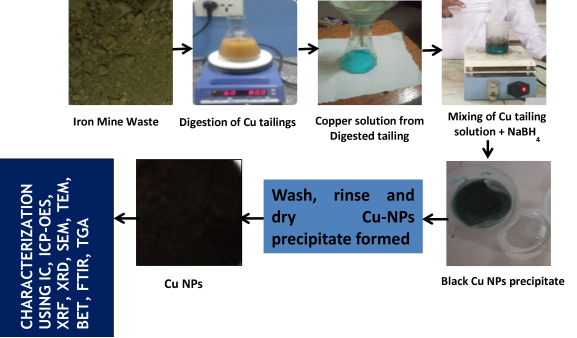
Figure 1. Experimental flow chart of synthesizing Cu NPs from copper tailings.
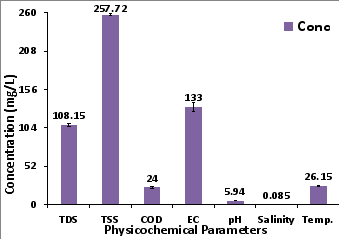
Figure 2. Physicochemical analysis of pulverized Cu tailing solution.
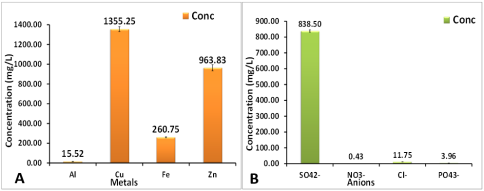
Figure 3. Metal ions (A) and Anions (B) of pulverized Cu tailing solution.
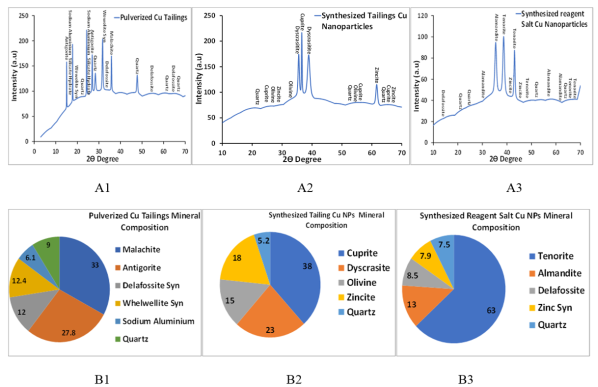
Figure 4. XRD spectrum (A) and mineral composition (B) of PCT, synthesized tailing Cu NPs, and reagent Cu NPs.
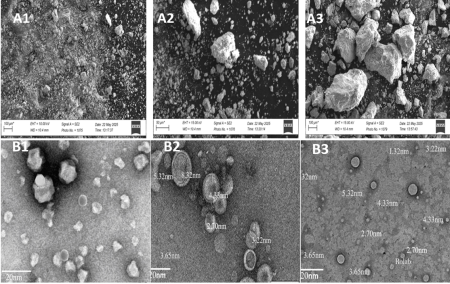
Figure 5. SEM Images (A) and TEM Morphology (B) of pulverized Cu tailing, synthesized tailing Cu NPs (B) and reagent Cu NPs (C).
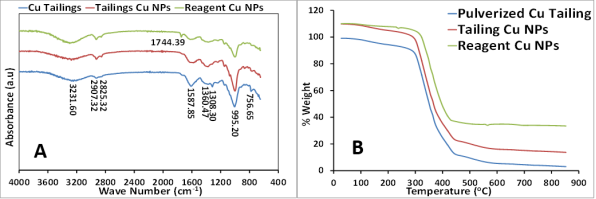
Figure 6. FTIR absorption bands (A) and TGA (B) of Pulverized Cu tailing, tailing Cu NPs and reagent Cu NPs.
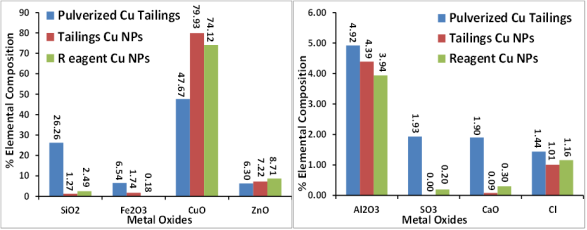
Figure 7. XRF elemental composition of Pulverized Cu tailing, tailing Cu NPs and reagent Cu NPs.
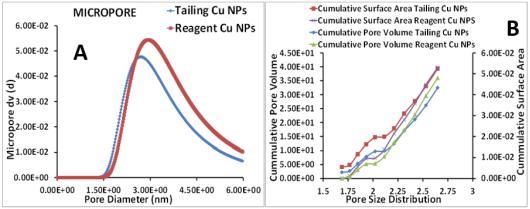
Figure 8. BET surface area of micropore volume (A) and pore size distribution (B) of tailing Cu NPs and reagent Cu NPs.
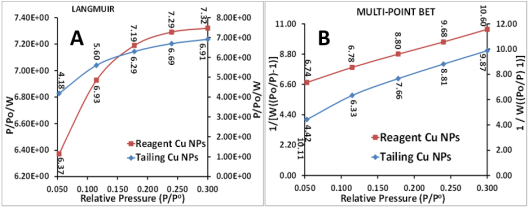
Figure 9. BET surface area of Langmuir (A) and multi-point BET (B) of tailing Cu NPs and reagent Cu NPs.




 Share This Article
 Twitter
 Linked In
 Facebook
 Copy
Copy Download